quifer Storage Recovery (ASR) is the storage of water in a well during times when water is available, and recovery of the water from the same well during times when it is needed. ASR provides a cost-effective solution to many of the world’s water management
needs, storing water during times of flood or when water
quality is good, and recovering it later during emergencies or times of
water shortage, or when water quality from the source may be poor. Large
water volumes are stored deep underground, reducing or eliminating the
need to construct large and expensive surface reservoirs. In many cases,
the storage zones are aquifers that have experienced long-term declines
in water levels due to heavy pumping to meet increasing urban and agricultural
water needs. Groundwater levels can then be restored if adequate water
is recharged.
quifer Storage Recovery (ASR) is the storage of water in a well during times when water is available, and recovery of the water from the same well during times when it is needed. ASR provides a cost-effective solution to many of the world’s water management
needs, storing water during times of flood or when water
quality is good, and recovering it later during emergencies or times of
water shortage, or when water quality from the source may be poor. Large
water volumes are stored deep underground, reducing or eliminating the
need to construct large and expensive surface reservoirs. In many cases,
the storage zones are aquifers that have experienced long-term declines
in water levels due to heavy pumping to meet increasing urban and agricultural
water needs. Groundwater levels can then be restored if adequate water
is recharged.
 he main driving force behind the current rapid implementation of ASR technology around the world is water supply economics. ASR systems can usually meet water management needs at less than half the capital cost of other water supply alternatives. When compared to alternatives requiring construction of water treatment
plants and surface reservoirs to meet increasing peak
demands, potential cost savings have been known to exceed 90%. A second
important driving force has been the increased recognition of this technology
as being good for the environment, aquatic and terrestrial ecosystems.
By reducing or eliminating the need for construction of dams, and by providing
reliable water supplies through diversions of flood flows instead of low
flows, ASR systems are usually considered to be environmentally friendly.
he main driving force behind the current rapid implementation of ASR technology around the world is water supply economics. ASR systems can usually meet water management needs at less than half the capital cost of other water supply alternatives. When compared to alternatives requiring construction of water treatment
plants and surface reservoirs to meet increasing peak
demands, potential cost savings have been known to exceed 90%. A second
important driving force has been the increased recognition of this technology
as being good for the environment, aquatic and terrestrial ecosystems.
By reducing or eliminating the need for construction of dams, and by providing
reliable water supplies through diversions of flood flows instead of low
flows, ASR systems are usually considered to be environmentally friendly.
 torage
zones range in depth from as shallow as about 75 m (200 f.) to as deep
as 900 m (2,700 ft). Groundwater levels in the storage zones
range from as much as 10 m (30 ft) above land surface
to more than 300 m (900 f.) below land surface. Natural water quality
in the storage zone ranges from fresh, suitable for drinking without treatment,
to brackish, including total dissolved solids concentrations up to about
5000 mg/l. Most sites have one or more natural water quality constituents
that are unsuitable for direct potable use except following treatment.
Such constituents may include iron, manganese, fluoride, hydrogen sulfide,
sulfate, chloride,
radium (224/226 /228), gross alpha radioactivity, and
other elements which are typically displaced by the stored water as the
"bubble" is formed underground. At one site, not currently in
operation, ASR was shown to be feasible and highly cost-effective, storing
drinking water in an aquifer containing seawater. For most of these sites,
it is first necessary to properly develop the storage zone around the
well, after which it is possible to recover the same volume as that stored.
At a few more challenging sites, water quality, hydraulic or geochemical
constraints may limit recovery to somewhat less than the volume stored.
torage
zones range in depth from as shallow as about 75 m (200 f.) to as deep
as 900 m (2,700 ft). Groundwater levels in the storage zones
range from as much as 10 m (30 ft) above land surface
to more than 300 m (900 f.) below land surface. Natural water quality
in the storage zone ranges from fresh, suitable for drinking without treatment,
to brackish, including total dissolved solids concentrations up to about
5000 mg/l. Most sites have one or more natural water quality constituents
that are unsuitable for direct potable use except following treatment.
Such constituents may include iron, manganese, fluoride, hydrogen sulfide,
sulfate, chloride,
radium (224/226 /228), gross alpha radioactivity, and
other elements which are typically displaced by the stored water as the
"bubble" is formed underground. At one site, not currently in
operation, ASR was shown to be feasible and highly cost-effective, storing
drinking water in an aquifer containing seawater. For most of these sites,
it is first necessary to properly develop the storage zone around the
well, after which it is possible to recover the same volume as that stored.
At a few more challenging sites, water quality, hydraulic or geochemical
constraints may limit recovery to somewhat less than the volume stored.
 ater
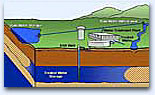
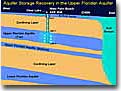
is stored deep underground in water-bearing geologic formations, or "aquifers,"
that may be in sand, clayey sand,
sandstone, gravel, limestone, dolomite, glacial drift,
basalt and other types of geologic settings. Stored water displaces the
water naturally present in the aquifer, creating a very large bubble around
the well. The bubble is usually confined by overlying and underlying geologic
formations that do not produce water. However, at several sites, the aquifer
is unconfined. Storage volumes in these bubbles range from as small as
about 50 Ml (13 million gallons) in individual ASR wells, to as much as
10,000 Ml (2.5 BG) or more in large ASR wellfields.
ater
is stored deep underground in water-bearing geologic formations, or "aquifers,"
that may be in sand, clayey sand,
sandstone, gravel, limestone, dolomite, glacial drift,
basalt and other types of geologic settings. Stored water displaces the
water naturally present in the aquifer, creating a very large bubble around
the well. The bubble is usually confined by overlying and underlying geologic
formations that do not produce water. However, at several sites, the aquifer
is unconfined. Storage volumes in these bubbles range from as small as
about 50 Ml (13 million gallons) in individual ASR wells, to as much as
10,000 Ml (2.5 BG) or more in large ASR wellfields.
ASR Applications
 ost ASR systems provide seasonal water storage, storing water during the wet season and recovering it during the following dry season. Many also use ASR for water banking, storing water during wet years and recovering it years later
during extended droughts. Increasingly, many water managers
are constructing ASR systems to ensure reliability during emergencies,
whether severe floods, earthquakes, contamination incidents, pipeline
breaks, or potential damage due to warfare or sabotage. Increasingly,
ASR is being considered for development of Strategic Water Reserves to
provide water supply security from terrorism or warfare. Actually, there
are at least 22 ASR applications, and others will undoubtedly follow.
ost ASR systems provide seasonal water storage, storing water during the wet season and recovering it during the following dry season. Many also use ASR for water banking, storing water during wet years and recovering it years later
during extended droughts. Increasingly, many water managers
are constructing ASR systems to ensure reliability during emergencies,
whether severe floods, earthquakes, contamination incidents, pipeline
breaks, or potential damage due to warfare or sabotage. Increasingly,
ASR is being considered for development of Strategic Water Reserves to
provide water supply security from terrorism or warfare. Actually, there
are at least 22 ASR applications, and others will undoubtedly follow.
ost operating ASR sites are storing treated drinking water. When recovered from storage, this water usually requires only disinfection before being sent out to the water distribution system. In recent years other applications of ASR technology have also begun.
 n the Tampa Bay area of Florida, which is an area with tremendous growth in water demand and limited
a vailable supplies, treated wastewater is reclaimed and piped to golf courses, parks, gardens and other areas requiring irrigation to reduce the demand for potable water. When the rains begin and irrigation demand ceases, reclaimed water is stored in ASR wells in deep brackish aquifers, from which it is recovered when needed to meet irrigation demands during dry periods. Reclaimed water ASR is therefore beginning to be a booming application of the ASR technology.
everal
sites are storing untreated groundwater pumped from overlying or underlying
aquifers, or from well fields located at great distances from the ASR
site. When needed, this water is recovered from the storage zone and combined
with whatever flows are then available from the
primary water sources, to help meet peak or emergency
water demands. In coastal areas subject to salt water intrusion, or other
areas subject to contamination or overpumping, ASR is being used to achieve
the full water supply benefits of local aquifers, which are then used
for water storage more than for water production. Groundwater ASR is increasingly
viewed as a desirable application of ASR technology.
he
newest ASR application is for storage of partially treated surface water.
Prior to recharge, water is treated sufficiently to ensure that the aquifer
does not plug with particulates or organic
material, and to ensure that the aquifer is not contaminated.
Generally, it is anticipated that the level of treatment will be less
than that required for production of drinking water. Stored water is recovered
to help meet peak demands for supplemental untreated water, whether for
urban needs, ecosystem protection, low streamflow maintenance, agricultural
irrigation, industrial water requirements, power plant cooling make-up
water, or other needs.
SR
is a unique technology, different than for production wells or injection
wells. Understanding ASR technology ensures success i n
almost all situations, whereas misunderstanding the unique aspects of
this technology can lead to failure, lost investment and disappointment.
n
almost all situations, whereas misunderstanding the unique aspects of
this technology can lead to failure, lost investment and disappointment.
 or
anyone who may be interested, I coined the term "aquifer storage
recovery" in 1983, when the first ASR system at Manatee
County, Florida, began successful operation. Development
of this system had been underway since 1978. Manatee County is completing
construction of its third phase of ASR expansion to include four wells
with a combined nominal capacity of 38 Ml/D (10 MGD).
or
anyone who may be interested, I coined the term "aquifer storage
recovery" in 1983, when the first ASR system at Manatee
County, Florida, began successful operation. Development
of this system had been underway since 1978. Manatee County is completing
construction of its third phase of ASR expansion to include four wells
with a combined nominal capacity of 38 Ml/D (10 MGD).









 n
almost all situations, whereas misunderstanding the unique aspects of
this technology can lead to failure, lost investment and disappointment.
n
almost all situations, whereas misunderstanding the unique aspects of
this technology can lead to failure, lost investment and disappointment.